

Research Peptides for Sale: What Vapers and Wellness Seekers Need to Know Before Buying
Research peptides are synthetic amino acid chains sold specifically for laboratory study and experimentation, not for human consumption. When you’re looking at this supplier or any vendor, you’re entering a market designed for scientists, researchers, and institutions conducting controlled studies on everything from cellular regeneration to metabolic pathways.
Here’s what you need to know upfront: these compounds occupy a gray zone that confuses a lot of people in the wellness community. Unlike the regulated supplements you’d find at your local health shop, research peptides aren’t approved by the FDA for human use. Vendors legally sell them only under the explicit understanding that they’re for in-vitro research, which means testing in lab environments, not in your body.
The confusion makes sense. Many peptides being studied in laboratories show promising results in early research for muscle growth, fat loss, anti-aging, and recovery. That creates demand from biohackers and wellness enthusiasts who’ve heard the buzz. But buying these compounds means stepping into territory where you’re responsible for understanding both the science and the legal boundaries.
This guide cuts through the marketing noise to help you understand what research peptides actually are, why they’re sold this way, and what questions you should ask before making any purchase decision. We’ll cover quality markers, testing standards, and red flags that separate legitimate research suppliers from operations that put profits over safety.
What Are Research Peptides (And Why Are They Showing Up Everywhere)?

You’ve probably seen peptides mentioned alongside everything from fitness supplements to anti-aging creams, and the term keeps popping up in wellness forums where vapers and CBD enthusiasts swap advice. But what exactly are these compounds, and why does every listing come with that cryptic “research purposes only” disclaimer?
At their most basic, peptides are short chains of amino acids, the same building blocks that make up proteins in your body. Think of them as smaller, simpler versions of proteins, typically containing anywhere from two to fifty amino acids linked together. Your body naturally produces thousands of different peptides that serve as chemical messengers, telling cells what to do and when to do it. Some regulate hormone production, others influence immune responses, and many play roles in tissue repair and metabolism.
The legitimate research side is substantial. Scientists study synthetic peptides to understand diseases, develop new medications, and explore how biological systems work. University labs and pharmaceutical companies use these compounds to investigate everything from muscle recovery mechanisms to potential cancer treatments. This work has led to FDA-approved peptide medications for conditions like diabetes and growth hormone deficiency.
So why are they showing up in wellness circles? Several factors converge here. The fitness community latched onto certain peptides years ago, drawn by research suggesting benefits for muscle growth and fat loss. That interest spread to broader wellness spaces where people experiment with biohacking and optimization strategies. Add social media amplification, influencer endorsements, and the same DIY spirit that drove CBD adoption, and you’ve got a perfect storm of curiosity.
The “research use only” label exists because these peptides haven’t gone through the rigorous testing required for FDA approval as drugs or supplements. Vendors can sell them legally for laboratory research, but cannot market them for human use. That distinction matters more than most buyers realize.
The Legal Landscape: Understanding What ‘Research Peptides for Sale’ Really Means
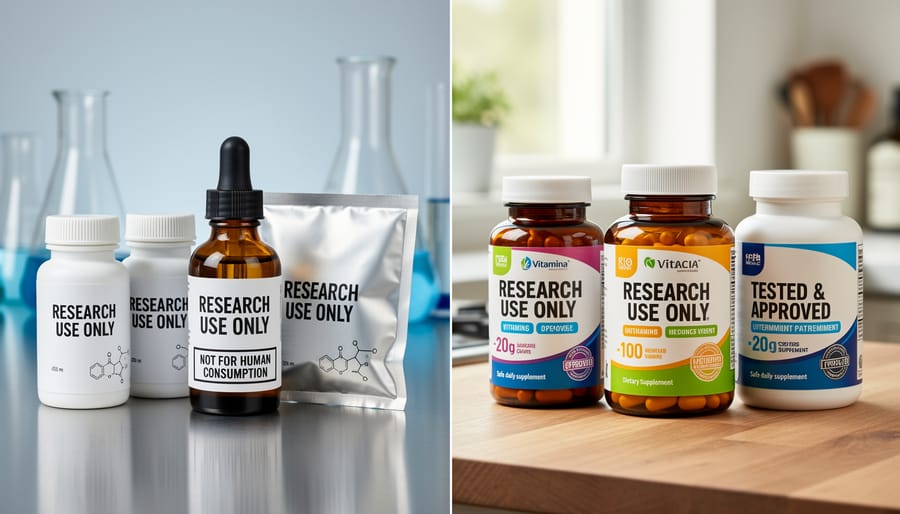
The phrase “research peptides for sale” isn’t just marketing language. It’s a legal designation with real consequences that every buyer needs to understand before making a purchase.
In the United States, peptides fall into a regulatory gray zone that confuses many newcomers. The FDA hasn’t approved most peptides for human consumption, which means vendors can’t legally sell them as supplements or medications. That’s where the “research use only” label comes in. It’s not a wink-and-nudge loophole. This designation means these compounds are intended for laboratory research, not human use, and sellers who market them otherwise risk serious legal trouble.
Here’s the distinction that matters: approved supplements have gone through testing and regulatory review for safety and efficacy in humans. Research chemicals haven’t. They exist in commerce specifically for scientific investigation, cell culture studies, and academic research. The moment a vendor suggests health benefits or dosing protocols for personal use, they’re crossing a line that can trigger FDA enforcement actions.
This creates a tricky situation for curious consumers. You can legally purchase research peptides in most states, but using them on yourself puts you in murky territory. There’s no quality control oversight ensuring what you bought matches the label, no dosage guidance backed by clinical trials, and no recourse if something goes wrong. You’re essentially conducting an uncontrolled experiment with your own body.
Some people draw parallels to the early days of CBD, when products existed in legal limbo before regulatory clarity emerged. But there’s a key difference. CBD benefited from the 2018 Farm Bill, which explicitly legalized hemp-derived products. Research peptides have no such legislation. They remain unregulated chemicals, and that status could change quickly if regulators decide to crack down.
The community needs to understand that “legal to buy” doesn’t mean “safe to use” or “approved for consumption.” Vendors slapping “research use only” on their bottles aren’t giving you permission to experiment. They’re protecting themselves legally while leaving you to navigate the risks alone.
Why This Matters to the Vaping and Alternative Wellness Community

If you’ve spent any time in vaping and wellness circles, you’ve probably noticed a pattern. Our community has always been early to explore alternatives that mainstream health hasn’t fully embraced yet. We were vaping when doctors were still skeptical. We were experimenting with CBD vape oil before dispensaries lined every corner. We’ve consistently sought out options that address stress and anxiety without relying solely on traditional pharmaceuticals.
Research peptides represent the latest frontier in this ongoing exploration, and they’ve surfaced in our conversations for the same reasons other compounds did: curiosity about what works, frustration with limited mainstream options, and a DIY spirit that values personal research over waiting for official approval.
But here’s where peptides differ significantly from nicotine alternatives or cannabinoids. While CBD and THC come from plants humans have used for thousands of years, peptides are synthesized compounds designed for specific biological research. They don’t have the same cultural history or the growing body of consumer safety data that cannabis products now enjoy. When you’re mixing your own vape juice or choosing a CBD tincture, you’re working with substances that have established consumer markets, quality standards, and at least some regulatory oversight.
Research peptides exist in a completely different space. They’re not intended for the same kind of personal experimentation that characterizes much of the alternative wellness movement. The “research only” label isn’t just legal cover, it reflects genuine unknowns about dosing, purity standards, long-term effects, and interactions with other substances many in our community use regularly.
The harm reduction ethos that defines vaping culture means making informed choices based on available evidence. With research peptides, that evidence simply doesn’t exist for consumer use. Understanding this distinction protects both individual health and the credibility of a community that’s fought hard to be taken seriously about the alternatives we do advocate for.
Red Flags When Shopping for Research Peptides
Shopping for research peptides requires the same skeptical eye you’d bring to any unregulated market. If you’ve spent time navigating CBD claims or sorting legitimate vape vendors from fly-by-night operations, you already have some of the instincts needed here.
The most glaring red flag is vendors making medical or therapeutic claims. If a site promises fat loss, muscle gain, anti-aging miracles, or healing properties, that’s not a research supplier. It’s someone either ignorant of the law or deliberately misleading buyers. Legitimate research chemical vendors stick to technical specifications and explicitly state products are not for human consumption. The moment you see before-and-after photos or testimonials about personal results, close that browser tab.
Price can signal trouble in both directions. Suspiciously cheap peptides often indicate poor quality control, degraded compounds, or outright substitution with cheaper alternatives. But sky-high prices don’t guarantee quality either. Research what typical pricing looks like across multiple established vendors to develop a baseline.
Missing or vague testing documentation should immediately concern you. Reputable suppliers provide third-party lab results showing purity, identity verification through methods like mass spectrometry, and proper storage conditions. If a vendor won’t share certificates of analysis or keeps them behind vague “available upon request” walls without delivering, that’s a problem. This transparency matters just as much as it does when evaluating wellness claims for any supplement or alternative health product.
Watch for websites that look thrown together overnight. Poor grammar, stock photos, no verifiable business address, and anonymous payment methods all suggest an operation that could disappear with your money. Check how long the domain has existed and whether the company maintains any presence in research or scientific communities.
Social proof requires scrutiny too. Fabricated reviews are common. Look for detailed feedback on independent forums rather than trusting on-site testimonials. The vaping community learned this lesson early when sorting quality manufacturers from cheap knockoffs. Apply that same vaping 101 consumer wisdom here.
If something feels off, trust that instinct. Better to walk away than risk your money or safety on a questionable vendor.
What Responsible Vendors Should Offer (Even for Research Products)
Just because peptides carry a “research only” label doesn’t mean vendors get a free pass on quality or ethics. Even for compounds not intended for human consumption, responsible suppliers maintain standards that separate legitimate operations from fly-by-night operations looking to make a quick buck.
Third-party testing certificates are non-negotiable. Reputable vendors provide certificates of analysis (COAs) from independent labs for every batch they sell. These documents verify purity percentages, identify contaminants, and confirm the peptide’s molecular identity. If a vendor won’t share COAs or claims “proprietary testing,” walk away. Legitimate research suppliers know that scientists and informed consumers demand verification.
Proper disclaimers and honest marketing matter too. Responsible vendors clearly state these products are for research purposes only and aren’t approved for human use. They don’t make health claims, post before-and-after photos, or include dosing instructions that wink at off-label use. Their websites focus on molecular information, storage requirements, and handling protocols, not transformation promises.
| Factor | Responsible Vendor | Questionable Vendor |
|---|---|---|
| Testing Documentation | Provides batch-specific COAs from independent labs | No COAs, vague testing claims, or self-testing only |
| Marketing Language | Research focus, molecular data, proper disclaimers | Health claims, dosing advice, transformation stories |
| Storage Information | Detailed handling, temperature, and stability data | Minimal or absent storage guidelines |
| Customer Support | Knowledgeable about products, responsive to questions | Generic responses, evasive about specifics |
Storage and handling information reveals a vendor’s legitimacy. Peptides are fragile molecules that degrade under the wrong conditions. Responsible suppliers provide detailed guidance on temperature requirements, reconstitution procedures, and shelf life. They ship products with appropriate cooling packs and explain why lyophilized (freeze-dried) forms typically offer better stability than pre-mixed solutions.
Transparent business practices round out the picture. Look for vendors with verifiable contact information, clear return policies (even if limited for research chemicals), and educational resources that focus on molecular science rather than biohacking promises. The companies treating these products with respect are the ones worth your consideration, even in an unregulated market.
The Bigger Picture: Making Informed Choices in the Wellness Space
The peptide conversation mirrors patterns we’ve seen before. Remember when CBD first entered mainstream awareness? Suddenly everyone was an expert, companies appeared overnight, and consumers faced a bewildering landscape of claims and counterclaims. The vaping industry went through similar growing pains, separating quality manufacturers from fly-by-night operators, learning to read lab reports, understanding what certifications actually meant.
Each time a new wellness trend emerges, the same dynamics play out. Early adopters experiment, information spreads through community channels, vendors rush to capitalize, and consumers must figure out who to trust. The difference now? We’ve learned something from previous cycles.
The wellness community has gotten better at asking questions. We’ve learned to demand third-party testing, to be skeptical of miracle claims, to share experiences honestly, both positive and negative. When someone mentions supporting their endocannabinoid system many now understand what that means and what it doesn’t. That’s progress.
Community knowledge-sharing matters more than any marketing campaign. The person who posts about their disappointing experience with a sketchy vendor helps others avoid the same mistake. The experienced user who explains how to interpret a certificate of analysis empowers newcomers. These conversations build collective wisdom.
Your responsibility extends beyond your own choices. When you research, verify sources, and make informed decisions, you’re not just protecting yourself, you’re setting standards for the entire market. Vendors respond to educated consumers. They improve transparency, upgrade quality control, and drop misleading claims when the community demands it.
Stay curious, stay critical, and keep talking to each other. That’s how we navigate this space safely.
The wellness landscape keeps evolving, and new products will continue entering the conversation, research peptides are just one example. What matters most isn’t chasing every trend, but approaching each one with the same critical thinking and community spirit that’s always defined the vaping and alternative wellness space.
You’re already part of a community that values harm reduction, questions oversimplified claims, and shares knowledge freely. Apply that same mindset here. When something sounds too good to be true or a vendor can’t answer basic questions about their products, trust your instincts. When regulations seem confusing, dig deeper rather than assuming everyone else has it figured out.
The conversations happening in vaping forums, CBD discussion groups, and wellness communities matter. Your questions help others learn. Your experiences, both good and bad, contribute to the collective knowledge that keeps everyone safer. Nobody has all the answers, and the regulatory landscape around emerging products remains messy and incomplete.
Stay curious, stay skeptical, and keep talking to each other. That’s how communities navigate uncharted territory without leaving people behind. The best defense against misleading marketing and questionable products isn’t just individual research, it’s a community that refuses to stop asking questions.